FEAST OF THE TRANSFIGURATION OF OUR LORD
ՏՕՆ ԱՅԼԱԿԵՐՊՈՒԹԵԱՆ ՏԵԱՌՆ ՄԵՐՈՅ
Այլակերպութիւն, the Transfiguration, is one of the five tabernacle feasts of our Church. In Armenian we know it also as Վարդավառ. The date moves each year, falling fourteen weeks after Easter, in the heart of summer.
What happened on the mountain
Peter had just confessed Him: You are the Christ, the Son of the Living God. And immediately our Lord told the disciples what was coming. He must go up to Jerusalem, suffer many things, be killed, and on the third day rise. They could not accept it, and Peter said so, and was rebuked for it.
Six days later He took Peter, James, and John up a high mountain, which our tradition names as Mount Tabor. There He was transfigured before them. His face shone like the sun and His garments became white as light. Moses and Elijah appeared and spoke with Him. Peter, not knowing what to say, offered to build three tabernacles. A bright cloud overshadowed them, and out of it came the Father's voice: This is My beloved Son, in whom I am well pleased. Listen to Him. The disciples fell on their faces in fear, until Jesus came and touched them and told them to rise and not be afraid. When they looked up, they saw no one but Him.
Coming down, He told them to say nothing of the vision until the Son of Man had risen from the dead.
The Gospel appointed for the feast is Matthew 16:13 through 17:13.
Why He showed them
He gave them His glory before He gave them His cross. When the hour came and they saw Him beaten and hanging and dead, they would have this to hold: they had seen who He was. The suffering would not be the whole truth about Him, because they had been shown the rest of it first.
This is the pattern of our faith. We are not asked to make sense of the cross on its own. We are shown the glory first, and it is offered to us again in the Divine Liturgy, in the mysteries, in the face of Christ.
Moses and Elijah
They are not there by accident. Moses stands for the Law and Elijah for the Prophets, and our Lord is the fulfillment of both. Moses died and was buried; Elijah was taken up alive. Standing together beside Christ, they show that He is Lord of the living and the dead alike, and that everything God had spoken through the Old Covenant finds its completion in Him.
Every earlier revelation of God, at the burning bush, on Sinai, in the still small voice, was a glimpse. Here it is given whole, in a human face.
What it means for us
Our Lord did not become something other than Himself on that mountain. He is always this. What changed was the disciples: for a moment they were given eyes to see what had been before them the whole time.
That is our destiny too. The Church teaches that we are made to be transformed by the glory of God, and not we alone but all creation with us. What Peter, James, and John saw on Tabor is what we are being made ready for.
On this day, O Lord, You revealed Yourself to Your disciples on Mount Tabor. Send down upon us the light of Your grace at Your second coming, and save us. (from the Introit of the feast)
Adapted from V. Rev. Fr. Ghevont Samoorian, DOMAR: A Compendium of Directorium and Calendar of the Armenian Apostolic Orthodox Church according to the traditions of the Apostolic See of Jerusalem (Armenian Orthodox Theological Research Institute, 2006).
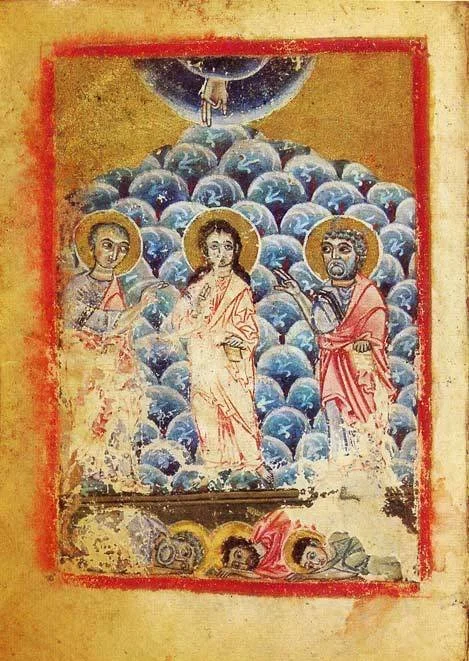
The Transfiguration of our Lord, by Momik, 1302, Noravank, ms6792 Matenadaran collection
Sourced from shnorhali.com