FEAST OF THE NATIVITY AND THEOPHANY OF OUR LORD JESUS CHRIST
ՏՕՆ ՍՈՒՐԲ ԾՆՆԴԵԱՆ ԵՒ ԱՍՏՈՒԱԾԱՅԱՅՏՆՈՒԹԵԱՆ
ՏԵԱՌՆ ՄԵՐՈՅ ՅԻՍՈՒՍԻ ՔՐԻՍՏՈՍԻ
On January 6 the Armenian Church celebrates the Birth and the Baptism of our Lord together, in a single feast we call Աստուածայայտնութիւն, Theophany, the revelation of God. It is one of the five tabernacle feasts, and unlike most others its date does not move. The celebration continues for eight days, an octave, from January 6 to 13.
One feast, one revelation
In the earliest centuries, Christians everywhere kept January 6 as the day God made Himself known in the flesh. The feast gathered a whole sequence of events from the Gospels: the Annunciation to the Holy Virgin, the Birth of Christ with the song of the heavenly hosts and the coming of the shepherds and the Magi, the Circumcision and the Naming of our Lord, the Presentation in the Temple, the Flight into Egypt and the return, the Baptism in the Jordan, the Temptation in the wilderness, and the witness of St. John the Forerunner. Across the octave these were remembered together, with the Birth and the Baptism at the center.
The Church joined them for a reason. In the Nativity, God takes on our flesh. In the Baptism, His divinity is declared and His ministry begins. Both are one act of self-disclosure, answering the same question: who is this?
Why other churches moved the date
In the earliest period, the Baptism was held in even higher honor than the Birth. By the fourth century, the Church in Rome had begun keeping the Nativity separately on December 25. Our tradition holds that it did so in part to draw the faithful away from a major pagan festival held on that day. The practice spread eastward, and it took hold especially in Jerusalem, where celebrating the Birth in Bethlehem and the Baptism at the Jordan on a single day had become impractical. Over the next two centuries, nearly every church adopted the new arrangement. Jerusalem, where we received the practice, was among the last to change. The Armenian Church saw no reason to change what it had received.
The Armenian Church saw no reason to change what it had received. January 6 remains our Christmas and our Theophany at once, as it was for all Christians at the beginning.
The other observances did shift in time. The Annunciation is kept on April 7, nine months before the Nativity. The Presentation in the Temple falls on February 14, forty days after. The Circumcision, the Naming of our Lord, the Temptation, the coming of the Magi, and the Flight into Egypt are all recalled during the octave.
The Blessing of Water
Following the Divine Liturgy on January 6, the Church celebrates Ջրօրհնեք, the Blessing of Water, commemorating our Lord's baptism in the Jordan. The service began in the Holy Land, at the river itself. As word of its beauty spread, communities elsewhere carried it out at riversides and seashores. Under Ottoman rule, public processions of this kind were forbidden, and the service moved inside the church, where it is celebrated to this day.
A large silver basin of water is set before the altar. The celebrant immerses a cross in the water, signifying Christ's entry into the Jordan. In procession, a silver vessel in the form of a dove, holding the holy muron, is brought forward as the choir sings Լոյս ի Լուսոյ, Light of Light. The water is blessed, and the celebrant pours a few drops of muron into it through the mouth of the dove.
Why a dove
At the Jordan, the whole Trinity was made known. The Father's voice was heard declaring Jesus His beloved Son. The Holy Spirit descended in the form of a dove. The Son stood in the water. What had been hidden was revealed, which is why the feast bears its name.
The dove-shaped vessel keeps that moment before our eyes. The Holy Spirit gives grace through the muron, and through the water blessed with it, to all who receive.
The Gospel appointed for the service is Matthew 3:1-17.
For families
Take home a bottle of the blessed water. Keep it where the family will see it, and use a little when someone is unwell, when you bless your home, or at the beginning of something new. Children remember what they have taken part in. A child who carries the water home is not watching a ceremony; she is bringing something of the Jordan into her own house.
Adapted from V. Rev. Fr. Ghevont Samoorian, DOMAR: A Compendium of Directorium and Calendar of the Armenian Apostolic Orthodox Church according to the traditions of the Apostolic See of Jerusalem (Armenian Orthodox Theological Research Institute, 2006).
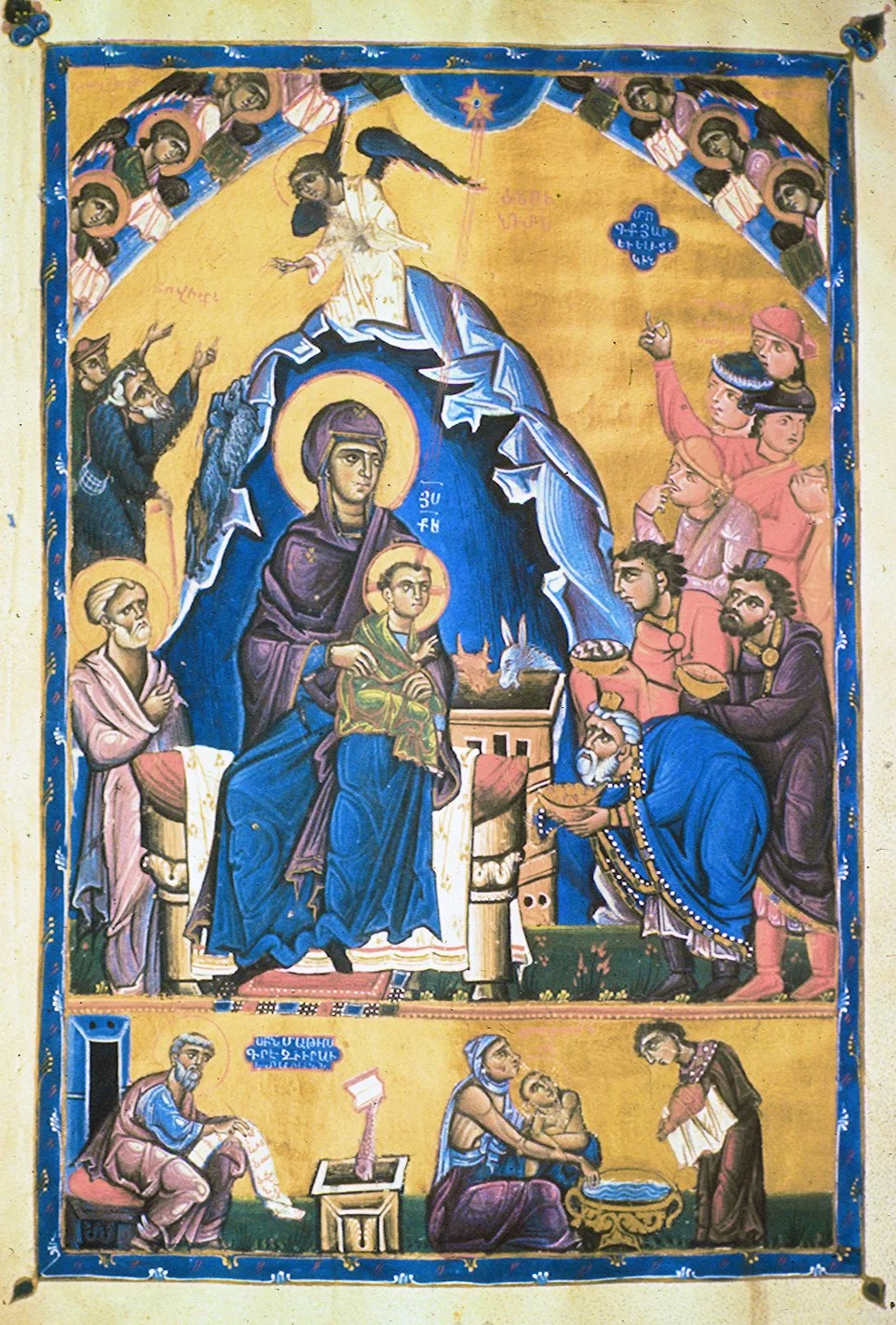
Adoration of the Magi, by Toros Roslin,
Gospel of Hromkla, 1260, ms251 Armenian Patriarchate of Jerusalem
Sourced from shnorhali.com