FEAST OF THE EXALTATION OF THE HOLY CROSS
ՏՕՆ ԽԱՉՎԵՐԱՑ
The Exaltation of the Holy Cross is the greatest of the four feasts our Church keeps in honor of the Holy Cross. Other churches observe it on September 14. In the Armenian tradition, it falls on the Sunday nearest that date, and so moves each year between September 11 and 17.
One of the five tabernacle feasts, Խաչվերաց, is preceded by a week of fasting, as are the Transfiguration and the Assumption. The feast has its eve, Նախատօնակ, and the following day is Merelotz, when we remember the departed. The days that follow are given to the Holy Church herself. This is not a change of subject. The Church was born from the Cross, from the blood and water that flowed from our Lord's side, and so the two cannot be spoken of apart from one another.
Three elevations
The feast rests on three occasions when the Holy Cross was lifted up before the faithful for veneration.
The first belongs to St. James, the Brother of our Lord and first bishop of Jerusalem. Our tradition holds that he raised a cross in blessing over the faithful, and that on that occasion the hymn we still sing was sung for the first time: we bow before your Cross, O Christ. It is a cross rather than the Holy Cross, because in those years the name of Christ was still spoken in fear, and it was not possible to go to Golgotha and recover openly what had been discarded there. That the faithful venerated even a cross in such circumstances tells us how early the sign of our salvation became an object of devotion.
The second is the recovery of the Holy Cross in Jerusalem through St. Helena, mother of the Emperor Constantine. Tradition tells of three crosses found together, and of a miracle by which the Lord's own was recognized. The Cross was then elevated at Jerusalem for the veneration of the faithful, who had witnessed the wonder. This event we commemorate separately, on the Sunday nearest October 26, as the Discovery of the Holy Cross.
The third is its return. The Cross was carried away into Persian captivity, and when at last it was brought home, the joy of our people was such that the memory of it shaped how we keep this feast to this day.
How we keep the feast
The Divine Liturgy is followed by the Antasdan, the solemn procession in which the four corners of the world are blessed, and the cross is adorned with basil. Sweet basil, ռեհան, is the herb of kings, and we place it on the Cross because the one who died upon it reigns.
In the valley of Garine there stood a peak known as Խաչափայտ, the Wooden Cross. Our tradition tells that when the Persians turned back to seize the Holy Cross again, the Armenians set it down upon that mountain and turned to face them, and drove them off. Returning, they found a spring of clear cold water flowing from the place where the Cross had rested. It became a place of pilgrimage, and a monastery of the Holy Cross stands at the foot of that mountain still.
What we celebrate
An instrument of execution has become the sign by which we bless our homes, our children, and ourselves. The Romans used the cross to shame those they killed on it. Our Lord took that shame and turned it into glory, and so we do not hide the Cross but lift it high. When we make its sign, we are not remembering something sorrowful. We are claiming what was won there.
Adapted from V. Rev. Fr. Ghevont Samoorian, DOMAR: A Compendium of Directorium and Calendar of the Armenian Apostolic Orthodox Church according to the traditions of the Apostolic See of Jerusalem (Armenian Orthodox Theological Research Institute, 2006), and from Koushagian, Saints and Feasts.
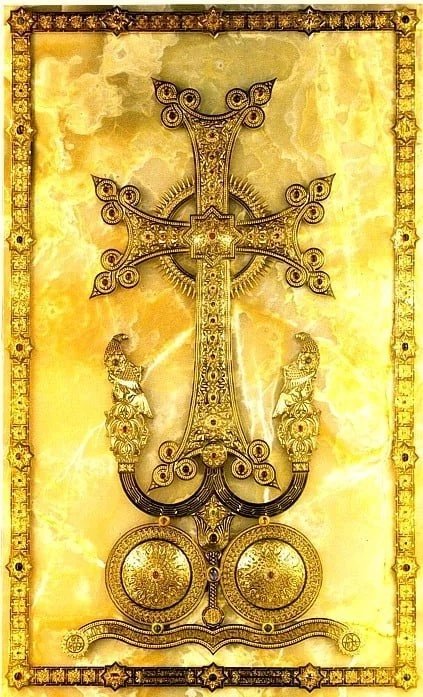
Խաչ Ծաղկեալ, the Blossoming Cross, in gilded silver on stone. Mother See of Holy Etchmiadzin
Sourced from armenian-history.com