FEAST OF THE ASSUMPTION OF THE HOLY MOTHER OF GOD
ՎԵՐԱՓՈԽՈՒՄՆ ՍՈՒՐԲ ԱՍՏՈՒԱԾԱԾՆԻ
This is the oldest of all the feasts the Church keeps in honor of the Holy Mother of God, and one of the five tabernacle feasts of our Church. It is observed on the Sunday nearest August 15, and so falls each year between August 12 and 18.
The feast is preceded by a week of fasting. Its eve is Նախատօնակ, and the day following is Merelotz, when we remember the departed. In earlier centuries the commemoration lasted three days; today it continues for nine. For the three weeks that follow, including the day of the feast itself, there is no fasting.
What we remember
After our Lord's Ascension, Scripture tells us almost nothing more of His Mother. We last see her in the upper room with the apostles, waiting for the Holy Spirit. What follows comes to us through Holy Tradition, and it is remembered in nearly the same form by all the ancient churches. Giragos Vartabed set it down in the sharagan Արեւելք Կերարփին.
The Holy Virgin remained in Jerusalem, cared for by St. John the Evangelist, and there she fell asleep. The apostles gathered and buried her with hymns in a tomb in the Garden of Gethsemane. Only St. Bartholomew was absent. When he returned and longed to look upon her once more, the others were moved to open the tomb, and it was empty. For three days and nights the voices of angels were heard. The apostles understood what had happened: her Son had taken her to Himself, as He had promised.
This is why we do not say that she died. We say that she fell asleep, and that she was taken up. Ննջումն and Վերափոխումն, the dormition and the assumption, are two words for one event.
Why it matters
What was promised to her is promised to all of us. She is the first of the redeemed, the one in whom the resurrection of the body is already fulfilled, and where she has gone the whole Church is going. This is why the empty tomb in Gethsemane is not a curiosity but a consolation. It is the shape of our own hope.
Our Church holds this and confesses it, but has never pronounced it a dogma required for salvation, as Rome did in 1950. We hold it as the Church has always held it: as something received, sung, and believed, rather than something legislated.
The Blessing of Grapes
Խաղողօրհնեք, the Blessing of Grapes, is customarily celebrated on this feast, and for most families it is the day's most beloved moment. It is a distinct service, given to the first fruits of the harvest. In Armenia the grape ripens in the latter half of August, and it is the fruit from which the wine of Holy Communion is made. Before eating of the new harvest, we bring the first of it to God and receive it back blessed.
There is no canon requiring that the service fall on this particular Sunday. It has simply come to belong here, and generations of our people have known the Assumption as the day the grapes are blessed.
Her life
Of her early life Scripture says little, and our tradition says more. She was of the house of David, and kinswoman to Elizabeth, who was of the line of Aaron. Tradition names her parents as Joachim and Anna, long childless and old when she was born to them, and tells us that they brought her to the Temple as a small child, as Hannah once brought Samuel.
At Nazareth the archangel Gabriel came to her, and she consented to bear the Son of God. She went then to Elizabeth, who greeted her as the mother of her Lord, and she answered with the song we still sing as Մեծացուսցէ. She bore her Son at Bethlehem, presented Him in the Temple, carried Him into Egypt and home again, and raised Him at Nazareth. She was at Cana. She stood at the foot of the Cross. She was in the upper room at Pentecost. From beginning to end, she was where her Son was.
Adapted from V. Rev. Fr. Ghevont Samoorian, DOMAR: A Compendium of Directorium and Calendar of the Armenian Apostolic Orthodox Church according to the traditions of the Apostolic See of Jerusalem (Armenian Orthodox Theological Research Institute, 2006).
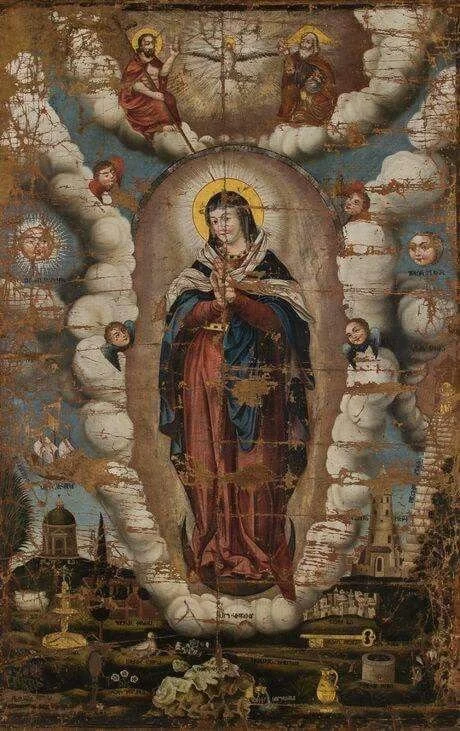
The Assumption of the Virgin Mary, artist Hovnatan Hovnatanian, 1760s, Echmiadzin x
Sourced from shnorhali.com